
Multiple Sclerosis Treatment Breakthrough: New Research Offer Real Hope for MS Recovery
For decades, the conversation around Multiple Sclerosis treatment has focused mainly on slowing down disease progression and managing symptoms. While those advances have been life-changing for many, a quiet hope has always lingered in the background, what if we could actually repair the damage MS causes?
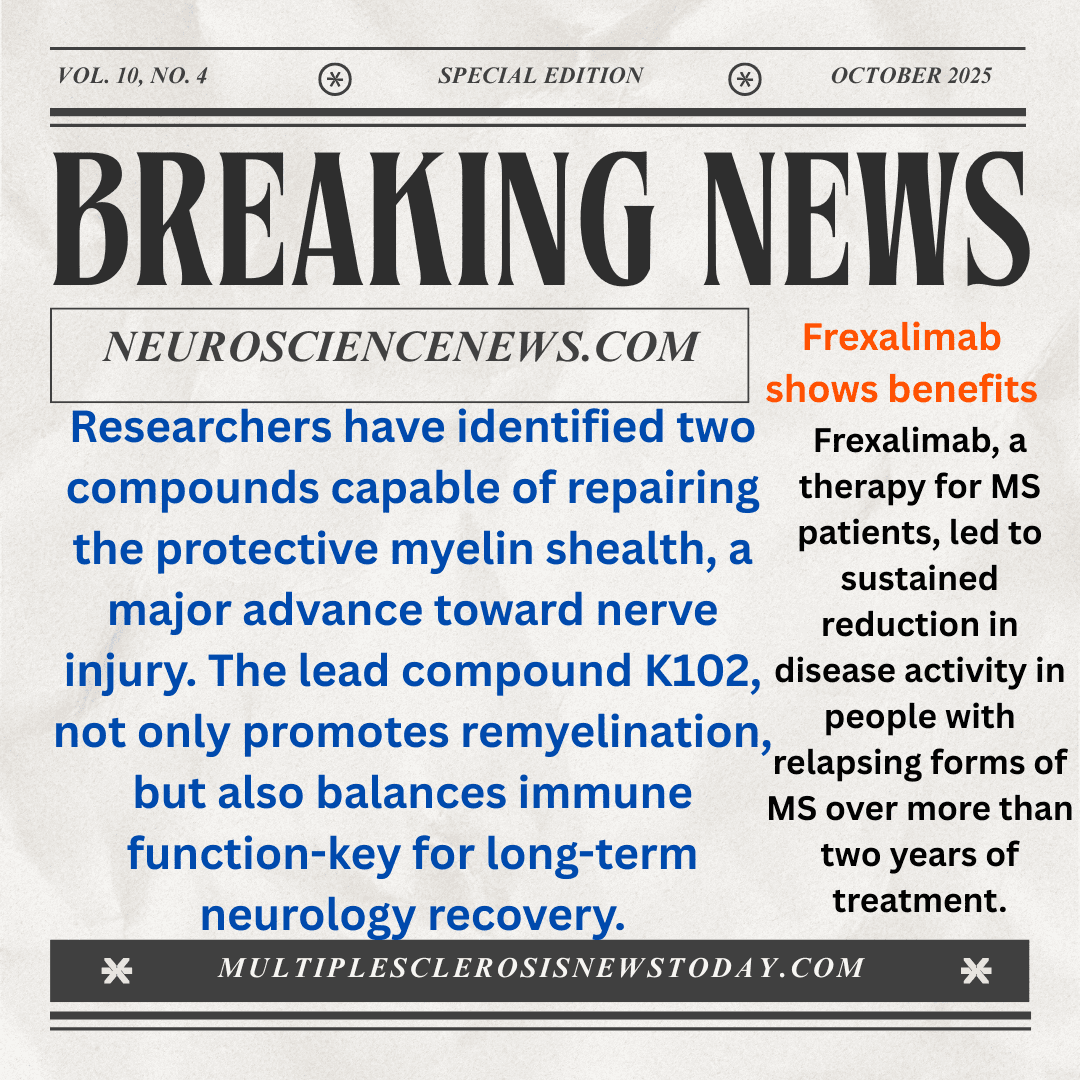
Recent discoveries from leading researchers are beginning to turn that hope into something real. Studies shared by NeuroscienceNews.com and MultipleSclerosisNewsToday.com are shedding light on groundbreaking new therapies, including a promising medication called Frexalimab, and two experimental compounds showing early potential for remyelination, the process of repairing damaged nerve coatings.
These developments mark one of the most hopeful moments yet in the future of MS care.
Understanding Multiple Sclerosis and Why Treatment Has Been So Challenging
Multiple Sclerosis (MS) is a complex autoimmune condition where the immune system mistakenly attacks the myelin sheath, the protective coating surrounding nerve fibers in the brain and spinal cord. When myelin breaks down, nerve signals slow or stop entirely, leading to the wide range of symptoms people experience: fatigue, balance problems, muscle weakness, numbness, and cognitive changes.
For years, the primary goal of Multiple Sclerosis treatment was to reduce inflammation and prevent new lesions from forming. While these therapies have been critical in slowing the disease’s progression, they have not been able to repair what was already lost. Once myelin was damaged, the body’s ability to rebuild it was limited.
That’s what makes this new wave of research so revolutionary.
Frexalimab: A Promising Step Toward Better MS Management
One of the most talked-about developments in the MS community right now is Frexalimab, a monoclonal antibody currently under study as a potential new therapy for relapsing forms of Multiple Sclerosis.
According to reports from MultipleSclerosisNewsToday.com, early clinical trial data suggest that Frexalimab targets and suppresses certain immune cells known as CD40L, which play a central role in the autoimmune attack on myelin. By blocking this pathway, Frexalimab may help reduce inflammation and prevent the immune system from damaging the nervous system further.
Researchers are hopeful that this approach could not only lessen relapses but also slow long-term progression — something many existing MS treatments struggle to do consistently.
Why This Matters
If larger trials confirm these results, Frexalimab could represent a new generation of MS drugs, ones that act precisely, with fewer side effects, while helping patients maintain more consistent control of their symptoms. For people who haven’t responded well to existing disease-modifying therapies, this could mean a fresh start.
The Dream of Repair: New Research Into Remyelination
Perhaps the most inspiring development reported by NeuroscienceNews.com involves the concept of remyelination, helping the body regrow the protective sheath around nerves that MS destroys.
In new preclinical studies, scientists have identified two promising compounds that seem to trigger natural repair processes in the nervous system. These molecules encourage specialized cells, known as oligodendrocytes, to form and rebuild damaged myelin.
While this research is still early, the implications are enormous. For the first time, scientists are not just focusing on preventing damage, they’re exploring how to reverse it.
Imagine a future where Multiple Sclerosis treatment doesn’t stop at slowing progression, but helps restore movement, coordination, and energy that was lost. That’s the vision driving these new studies.
What Remyelination Could Mean for Everyday Life
For people living with MS, even small improvements can mean a world of difference — walking a little farther, feeling less fatigue, or being able to hold a steady conversation without cognitive fog.
Remyelination therapies, if they prove effective, could bring a new level of healing that existing medications haven’t been able to achieve. It’s not a cure, not yet, but it’s a genuine step toward restoring quality of life.
A Turning Point in Multiple Sclerosis Treatment
Taken together, these discoveries suggest something powerful: the future of Multiple Sclerosis treatment may be shifting from “management” to healing.
Frexalimab’s immune-targeting precision offers a potential way to protect the brain from new damage, while remyelination research opens the door to repairing what’s already been lost.
For patients, caregivers, and advocates, this represents more than scientific progress, it’s emotional progress. It’s the feeling that after decades of slow, uphill battles, momentum is building toward a future with real recovery on the horizon.
Staying Hopeful While Staying Grounded
It’s important to note that Frexalimab is still being studied, and the remyelination compounds are in very early testing stages. But hope doesn’t mean ignoring reality, it means recognizing forward motion, however gradual it may be.
Clinical trials take time, and not every therapy will make it to approval. Still, every discovery teaches researchers more about how to outsmart MS, and each success brings the community one step closer to a treatment that not only stops progression but helps people reclaim what MS took away.
The Human Side of Progress
Behind every headline about a “breakthrough” are real people: researchers working late in labs, doctors testing new protocols, and patients courageously participating in clinical trials. Each plays a part in this evolving story.
As someone living with MS, or supporting someone who is, you are also part of that story. Every day you manage symptoms, adapt, and keep going, you embody the same resilience that drives the science forward.
Moving Forward With Hope
The latest studies from NeuroscienceNews.com and MultipleSclerosisNewsToday.com remind us of something vital: progress is happening.
It may not yet be a cure, but it’s clear the scientific community is closer than ever to unlocking new ways to protect, repair, and renew the nervous system.
If you or someone you love is living with MS, take heart. The landscape of Multiple Sclerosis treatment is changing, and hope, once a fragile whisper, is becoming something stronger, something tangible.
The future of MS care is no longer just about surviving.
It’s about rebuilding.
And that’s a future worth holding onto.
Recent Posts

Mobility Devices for MS Fatigue: What Helps Most
MARCH 26, 2026

MS Mobility Devices: A Beginner’s Guide to Mobility and Home Supports
MARCH 25, 2026

Confidence With Multiple Sclerosis: Rebuilding Self-Trust
JANUARY 25, 2026

Multiple Sclerosis Symptoms: Early Signs, Invisible Challenges & Daily Changes
JANUARY 16, 2026

Walking With MS: How to Stay Safe, Steady, and Confident
DECEMBER 16, 2025

Living with Multiple Sclerosis: What Daily Life Can Look Like
DECEMBER 15, 2025